
Showing posts with label SRTOL. Show all posts
Showing posts with label SRTOL. Show all posts
Tuesday, May 10, 2011
Body art
I know stories of people not getting jobs (in banks, as nurses) because of their tattoos. I keep thinking this would make a good paper topic for the SRTOL paper, but I haven't seen it done well yet. Cracked has a funny post on this. See also my bookmarks.

Monday, March 7, 2011
On word count and length requirements
I've never understood when students turn in work that doesn't meet the word count or length requirements, especially on the papers after the first turned in for grade.
If you've played a sport - or studied a martial art - consider this analogy. In basket ball or football coaches routinely ask their players to run sprints, where (in Bb for example) they run from baseline to touch the free-throw line, then return and touch the baseline and then run to touch the mid-court line, return to baseline, sprint to far court free throw line, back to baseline then run full court and back. This completes one cycle. Different teams may have different names for the drill, but the drill is repeated multiple times in a practice. [update: most common name according to students - suicides]. Football will use the grid lines on the field and go 10 yrds and back, then 20 yrds, etc.
These drills develop agility, build endurance and foster team dynamics. But players don't enjoy them.
What would a coach do, if asking players to run 5 cycles, a player runs just 1 or 2, then says, "Well coach. You get the point. I think I've shown I understand the drill. I like to be concise."?
Or imagine if you study martial arts, like: wrestling, kung-fu, karate, aikedo or the like. When the coach/teacher (and in Asian martial arts the coach is addressed as "teacher" - Sensei means teacher in Japanese, Lao Sher means teacher in Chinese - these cultures respect teachers as much as Americans respect coaches) - when a new move is taught the coach/ teacher will ask the student/ athlete to repeat the move multiple times - or for a set period of time - say 5 minutes. This builds muscle memory and as well ties verbal and visual instruction to physical movement - which creates neural pathways that make permanent the memory and facilitate recall.
What would a martial arts instructor do if the student/athlete did one repetition and said, "That's enough. I get it. I won't do any more"?
Having participated in formal athletics - and been a scholarship athlete in a martial art - I am hard pressed to remember an example of a student questioning a coaches request for repetitive action, though martial arts instructors are famous for stepping in and working on the move in question with students - which when studying a pugilistic sport, may amount to a butt whipping.
Why is there reluctance to meet minimal length requirements? Colleagues I worked with at KU would simply fail or not grade a paper that failed to meet any minimal requirement. This seems logical.
How can we address rhetoric and grammar, and be fair to all students, if most follow directions and take the necessary risks involved with engagement with the assignment - but some take far fewer risks, and disclose much less information?
Sunday, October 3, 2010
What I'm Learning from the SRTOL Essays: FA2010
- I want students to get away from the idea of correct or incorrect grammar. This thinking indicates a prescriptive rather than descriptive definition of grammar - and runs counter to the goal of the assignment; however, if someone really wants to go there - plan on defining grammar in detail.
- So many thesis statements ended up on the last page. I specifically asked for them in the first paragraph, and in 85% or more of published essays that's where you find them. It makes reading easier and more predictable. Someone this semester asked if they could put the thesis on the last page. I said they could, but that doesn't mean one should. In every case so far where I find the thesis after the first 2 paragraphs it looks like the author wrote until they discovered the thesis then quit when they hit minimum length requirements: typical first draft stuff. They generally should have then moved the thesis to the first paragraph, and then pruned the essay down to just what is relevant or implied by the thesis. Then add support and detail to what's left.

- I'm seeing too "many" superfluous quotes. Wikipedia calls this Scare Quotes. Avoid this. I don't like irony conveyed through quotation marks. Use words. And they don't work for emphasis. Serious explanation here. Check out the blog dedicated to unnecessary quotes here - or the Facebook group - seriously.
- Cliche alert - avoid "in today's society."
- Regarding format specifications. Ignoring format requests is antisocial and passive aggressive.
- Overly wordy introductions to quotes - transitions are needed - but empty and redundant information isn't. I repeatedly see, "In the journal article __________ published in ______ by the author _______ it says..." All this information is on the works consulted page - right? So a shorter reference will work. The wordy version makes it almost an appeal to authority. "Smith argues, "Blah, blah, blah" will work just as well. Or "Blah, blah, blah"(Smith 45).
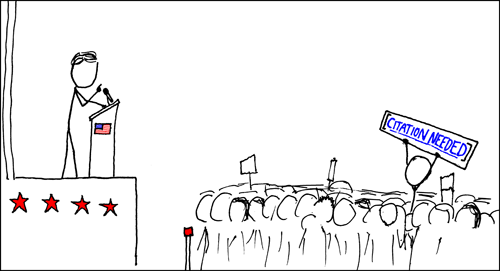
- EVERY SOURCE USED OR MENTIONED SHOWS UP ON THE WORKS PAGE! This is a big deal. Just because I may know of the article, doesn't mean you're excused from citing the source. We need to demonstrate the ability to work with sources. That's a huge objective of this class.
- "some people say" is a red flag for a specious argument and a need for more research and support.
http://imgs.xkcd.com/comics/wikipedian_protester.png
Thursday, September 2, 2010
Writing and Power
 Grabbed the above image from a boingboing post on Woody Guthrie, an old artist activist who wrote a couple of my favorite songs (the motorcycle song and alice's restaurant).
I like it because it highlights a point I try to make with my classes - that language, and writing specifically, is all about power.
Thursday, July 22, 2010
Linguistic integrity? Royal order of linguistic prejudice?
 People often assume to know my position on English Only laws and proposals - but my take is nuanced and complicated. Linguistic integrity is an interesting idea - but it hasn't been tried yet.
WHY do Asian menus refer to squid by an Italian word? The picture comes from a Japanese restaurant - examples like it can be found in most Chinese menus. Is the assumption that Americans developed a taste for squid only because they don't know what it really is? Chinese menus should call it Yo Ewe, (乌贼 or "oil fish," which reminds you of the high cholesterol). I'd like to know what it's called in Japanese (FYI: Octopus is called "taco" in Japan). And do people who support English only legislation eat Mexican food? If so what do they call tortillas? Or tacos? Are there "English" words for these?
I suspect a royal order of linguistic prejudice. In America monolingual speakers code-switch according to a hierarchy of non-English languages: French and German come first, followed by other languages spoken by white WASPish countries, then Japanese, other Asian languages - the least popular language to gather words from is Chinese. This explains why there are so few cognates and why Americans use the word "Kangi" in the least appropriate circumstances.
"Kan gi" (or Kanji) - is Japanese language way to say "Chinese characters," as in (Kan = Chinese) + (gi = characters) - but American hipsters will refer to Chinese characters as "kangi," even when discussing texts in and/or from China! Boing boing - one of my favorite blogs - is a great place to find this. See comments - here - where if you scroll to comment #57 you can see where I have broached this issue , or here (scroll thu comments) where moderators and commentators alike use a Japanese phrase to say the word Chinese when talking about China. It amounts to China bashing.

Friday, April 2, 2010
Teabonics
I'm hijacking images from a post from Boing Boing ( since I use links - it's legal).
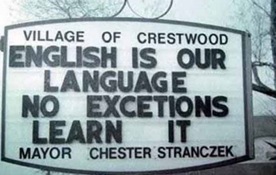

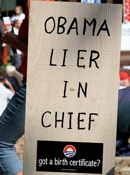
How do these images apply to our discussion of students' right to their own language?
How do these images apply to our discussion of students' right to their own language?
Thursday, March 11, 2010
What I'm learning Re: SRTOL Papers - Rhetoric
These comments apply to many papers.
I see semantic confusion facts vs. opinions (if this is a rhetorical ploy - it doesn't work on the well-educated; consider your audience).I hear semantic confusion. Define terms as you will use them. The papers have taught me that voice may be to dialect what an individual is to a small community. Voice may be personal and unique - and dialect may be where we find social connections and collective identity. No class has discussed "Voice" as eloquently as this semester. Consult reference books but don't directly quote them unless absolutely necessary. Paraphrase - define for yourself. Goals of this class require demonstration of nuanced understanding of at least all the terms and concepts listed here. 2 people used the word "slang." What did I say about that? (Scroll down page of link to see written record).
People still call America a "melting pot"? For at least a couple decades (before most of you were born) I've read and been told this metaphor oppresses individual rights. Everything that goes into such a pot loses its individuality and unique/ distinctive characteristics and integrity. It disappears into the stew (or is it a pot of molten metal which produces new alloys? As a kid I saw metal), hence the politically correct image: we are a "tossed salad." Each item contributes to a whole while retaining its integrity and individual flavor. At least a dozen or so papers so far go off on the melting pot analogy. Is the tossed salad thing political correctness gone too far? Do we need the melting pot analogy? Why? Are students reacting against political correctness or have they simply been exposed exclusively to conservative/ dated images?
The people who founded this country spoke English so ... (immigrants should learn it, we should all have a standard dialect, etc)? This argument reminds me of the assertion that English was good enough for Christ, it should be good enough for immigrants. Re: English roots of our founders:
- What about the millions of Native Americans who'd lived here for millennia. Don't they count? Why not?
- What about California and the west, as well as Florida - which if we discount native Americans (big if) were settled by Spanish speakers and which Spain claimed or settled before England or colonials?
- In lands added to the United States by the Louisiana purchase (from France) - this includes Kansas - the original white settlers/ missionaries spoke French.
- BTW - Most know Kansas takes its name from the Kansa Indians - so why the superflous "s" at the end? Appleton's Journal- volume 15 page 758, published in 1876, as well as other sources - notes that it is the phonetic English pronunciation of notes taken by French missionaries. In French final "s" sounds get dropped. Our current state name results from a mispronunciation due to common ignorance of French and or the etymology of the name. If we appeal to tradition/ origins should we start pronouncing our state's name "Kansa"?
Wednesday, March 3, 2010
What I'm learning Re: SRTOL Papers - citing sources
I've only read a handful of papers. 1/2 have been amazing, and half have been ... uninspiring but generally ok. That's not too bad. Some advice, tips or clarifications for you-all.
In text quotations
Re: block quotations. Only one person's followed MLA so far. I notice Purdue's OWL and several other sources get it WRONG. Page 7 of the PDF Norton provides free online re: MLA format says:
Also:
In text quotations
Re: block quotations. Only one person's followed MLA so far. I notice Purdue's OWL and several other sources get it WRONG. Page 7 of the PDF Norton provides free online re: MLA format says:
When quoting more than three lines of poetry, more than four lines of prose, or dialogue from a drama, set off the quotation from the rest of your text, indenting it one inch (or ten spaces) from the left margin. Do not use quotation marks. Place any parenthetical documentation after the final punctuation. [emphasis mine]See also the sample paper page 5 on pdf page 46.
Also:
- every source quoted or used to support an argument should show up in the works page. Even when you quote media such as: songs, films, TV, etc.
- if you quote something, there needs to be and immediate (or ajacent) indication of where to find citation info on the works page. Usually this is the author's last name.
- when quoting, include page #'s to help readers find the original quote. This is essential if quoting from a book, or database that uses PDF's with page #'s, or a periodical or anything that provides page #'s. Assume the reader will track down your quote, and make it easy. You may have to go back yourself.
Friday, February 19, 2010
Re: Students' Right to Their Own Language
Don't worry about taking the wrong position on this topic. I've argued both sides. In graduate seminars in Education, they teach that educators struggle to balance 3 needs or demands: the student, the society and the curriculum. No one can privileged all of these needs equally, and making any one concern a priority reduces the focus on the other 2. My position depends on the environment and what concerns seem the most critical or neglected in that context. Don't try to guess my position. It's a recipe for disaster for several reasons. I tried this a few times with professors and it never worked out.
The 4C's statement of students' right to their own language privileges society over individual students - as I see it from my seat in an American community college - and my bias runs counter to that. My experience and interests also lie with non-Native English speakers and linguistic minority groups, and yet I come to conclusions that may differ from the majority of my colleagues with similar experience and interests. My childhood personality and a variety of influences that shaped me since - thru my admiration or thru my rebellion - result in a pragmatism. Many colleagues I respect, and my sister, reject pragmatism.
How this relates to your writing:
Sometimes we write for discovery, not figuring out what we truly believe until we finish. Sometimes we start with a problem and write our way out of it - figuring out in the end through examining what we believe. Maybe in the past teachers taught you to start with a rockin' thesis statement and then find quotes to support your position, but isn't what true scholarship looks like at the college level. I recently made the analogy in class that too many students were using research the way a drunk uses a light post, for support rather than illumination.
Learning changes the way we think, or the tools we have for understanding. It stands to reason that what we read will affect our thesis. The thesis typically evolves.
More than a few students in my office this week have decided to scrap their papers and start over. That isn't a sign of failure. I've done that more than a few times myself. This happens in the writing process and we shouldn't consider the effort wasted.
What's been threatening my sleep
 Just a few blocks down the street from me - on my daily route to and from work - something huge and bad has happened within the last 72 hours. At least 3 agencies, including state and federal (ATF, Animal Control, Sheriff's Office confirmed so far), have been cooperating - and doing and excellent job of not releasing information.
For the first 24 hours the helicopters annoyed me. I counted at least 3, and identified 2 as news crews from Kansas City. KCTV 5 and Channel 9 had mobile units camped out for the first 36 hours - and one crew was still there 2 days after the initial raid. The Emergency Response Command Unit ( a big honkin' RV) just left.
The way people respond to the excitement and lack of information interests me as much as the language skills and usage of the people commenting on the local paper's online post (blog). Interesting discussions about appropriate use of written language and the relationship to class and social status relates to class discussions - as does the lack of civility (and moments of kindness) on the message boards. Several well-intentioned members of the accused s' families have been compulsively attending and contributing to the discussions - which have some rather silly participants as well as some real trolls. The back and forth disturbs me and compels my attention. Loads of lurid elements and history connected to that patch of real estate. The packs of wild dogs are real, and I remember the guy the exotic dancer ran over (he went to sleep in the middle of the road walking home from the club) but many of the stories strain credibility way too far.
Wednesday, February 10, 2010
Gen 1.5
On a surprising number of Comp 1 papers this week, I find myself writing about the Gen 1.5 experience and how excited I am to have students with first-hand knowledge. This could be an topic for the SRTOL paper.
Generation 1.5 refers to students with the characteristics of both 1st generation immigrants and 2nd generation immigrants. They typically entered the U.S. in their childhood - though some sources say true Gen 1.5 students enter between the ages of 3-5, and other sources say they enter the country as teenagers. All agree that the experience involves public schools during a pre-adolescent or early adolescent stage.
Kids seem to learn language better than adults, and partly because kids play. Gen 1.5 youth learn language more from the playground, or extra-curricular activities, than the classroom. Their oral skills rival native born English speakers, which can cause problems. Other native speakers assume Gen 1.5 are fully fluent and cultural insiders. Sometimes people have less patience for Gen 1.5 learners because on the surface they look and sound fully "American," and yet they don't catch every word or cultural reference that a student born to 2nd or 3rd generation Americans might. I see this with how people treat my wife - tho she's 1st generation with phenomenal language skills.
Gen 1.5 face particular challenges with writing. At least 6 of my Gen 1.5 students have told me stories this week of being laughed at by students and mocked by teachers. Generally the Asian students smile and laugh with the group.
Therese Thonus, now Writing Center Director at KU, wrote an interesting piece on the essential role of writing centers for Gen 1.5 students. It's titled, "Serving Generation 1.5 Learners in the University Writing Center," published in TESOL Journal in 2003. Look for it in the Eric Database or thru google scholar. Gen 1.5 students need to disclose their linguistic background to the peer consultant at the WC and ask them to function as a cultural informant. Most people assume Gen 1.5 students can hear grammatical anomalies as well as native English speakers, but they don't.
Mark Roberge explains it in easy-to-understand language, but I disagree with him on a couple key points. 1) age is much more flexible than he suggests and 2) they do have a home language - though it may be defined as an interlanguage (see also creole, pidgin, etc). Interlanguages count as "a language of nurture" for the Students Right to Their Own Language paper, though academics have been slow to realize and acknowledge that.
What American location is most famous for it's creole? New Orleans - They just won the Superbowl and everyone's yelling, "who dat." Ever wonder what that means or where it came from?
I'd like to share research at the social bookmarking site.
Tuesday, February 9, 2010
Superbowl, gender diversity and the SRTOL paper
 Absenteeism was up for my 2 classes on Monday. Some research shows this may be caused by the Superbowl. See a scholarly journal here, or see a more news magazine article here. It could also have been the weather.
Maybe people stayed home because they don't have a draft of the Students Right to Their Own Language paper.
I've had some ideas lately. Given arguments expressed in class and in videos on the wiki that fashion is a form of expression and analogous to style or "voice" in writing, could we treat body art as communication, and a type of language, and thereby bring discussion of tattoos, piercings and other body modifications into our discussion of students' rights to their own language? The chart at the bottom of the recent post on diversity notes generational changes in attitudes toward body art.
If students have a right to expression through body art, where does that leave us on transgendered issues? By the way JCCC has invited Donna Ross in GEB 233 at 2pm on Thursday. She's undergone the transition and will be answering questions.

Am I still on topic in asking, if students have a right to their own language, how do I as an instructor respond to the comment in a student paper, "I know it's gay, but my girlfriend gave me the Twilight books, and I read them."
I know the "it's so gay" comment is inappropriate - but as my guest speaker Miguel pointed out last semester - in certain situations and in certain audiences gay people use it. Is it exclusively the purview of homosexual groups, or are there times and places where anyone can use it, or is it a word any young person should be allowed to use because it means something different today than it did in the old days?
BTW: the Queer & Allies group meets Wednesday at 2 pm in CC 212. Maybe someone could take these questions to them.
Monday, January 11, 2010
diversity
I wonder if the cartoon (from SMBC) has a point. If so, what bigotry will traditional (18-21ish) students reject? And what bigotry will they hold on to? Interestingly within a week or so of this cartoon the reputable Pew Research Center wrote on this topic in, "Millenials views ...not so different." The matix below the cartoon  comes from their research. You likely will have to scroll down for it - but it's provocative.
I wonder if profs tend to unfairly assume their students are less open- minded? Maybe it depends on the academic discipline. Or, as a few former colleagues have put it, "everyone is prejudiced." That statement has bothered me in the past. What's that say about the speaker? What about Mother Theresa? The statement may not be wrong, but...
If you're interested in this topic check out some links collected at the social bookmarking site under these tags: diversity, gender, or race
TheDaily Show's Wyatt Cenac takes a funny look at the subject on the Jan. 12th 2010 show.

comes from their research. You likely will have to scroll down for it - but it's provocative.I wonder if profs tend to unfairly assume their students are less open- minded? Maybe it depends on the academic discipline. Or, as a few former colleagues have put it, "everyone is prejudiced." That statement has bothered me in the past. What's that say about the speaker? What about Mother Theresa? The statement may not be wrong, but...
If you're interested in this topic check out some links collected at the social bookmarking site under these tags: diversity, gender, or race
TheDaily Show's Wyatt Cenac takes a funny look at the subject on the Jan. 12th 2010 show.
Tuesday, September 29, 2009
MLA documentation
Hopefully you've checked out what I've posted before on documentation in general. It looks like people are doing google searches for research - even though we found great research in the library using the database. I'm seeing sources that don't impress me and don't lend anyone credibility. Anyone can get a web site and say anything. If you want to do a web search use Google Scholar. It provides much better sources. Best bet -though - is the library database.
Norton has some resources on how to document sources in MLA format. they even provide a free PDF of the MLA updates - and IT CONTAINS A SAMPLE PAPER! (go to page 40). It's amazing how much I can tell from just a superficial glance at the physical format of a paper. Look at a sample paper.
I also recommend Citation Machine. Click MLA and follow directions.
We should all cite the 4 C's statement that we are responding to. You can find it several places. I put a phrase from the statement in quotes and entered it in Google Scholar. One site quoted it in its entirety - it's full text through JSTOR. I took info from that page and entered it into citation machine and voila!
Gilyard, Keith. "African American Contributions to Composition Studies." National Council of Teachers of English. 50.4 (1999): 639. Web.
It doesn't have the hanging indent - which is tough in electronic formats like blogs, web pages, etc. but otherwise it's solid. Notice you don't need or want "volume" or "Vol." or "page" ... if everything is in the right place I know the volume 50, the number is 4 and the page is 639.
Tuesday, September 15, 2009
Students Right to their Own Language
Perennial old-school curricular curmudgeon Stanley Fish has recently published a series of blog posts on composition instruction (see also part 2, part 3). He speaks directly to a writing prompt I've given one of my classes. As something of a coup de grace of rhetorical flourish he concludes,
His comment, on the advisability of dialogue with students re: linguistic systems and democratic values, gives me pause for thought. Have we not done that in class? Has it been successful?
First, you must clear your mind of the orthodoxies that have taken hold in the composition world. The main orthodoxy is nicely encapsulated in this resolution adopted in 1974 by the Conference on College Composition and Communication: “We affirm the students’ right to their own patterns and varieties of language — the dialects of their nurture or whatever dialects in which they find their own identity and style”[hotlinks mine].His post is a fairly lengthy response to my prompt; he just didn't know it. Personally I feel about his ideas the way I feel about my grandma's rendered pork cracklings: way salty, good with beer, and satisfying, despite the fact that you can feel your arteries hardening. We're talking a serious fat and cholesterol cocktail of epic proportions. Everything has consequences.
His comment, on the advisability of dialogue with students re: linguistic systems and democratic values, gives me pause for thought. Have we not done that in class? Has it been successful?
Subscribe to:
Posts (Atom)