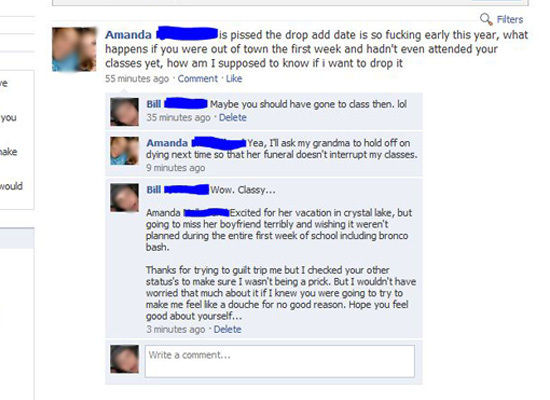
 Got this from a post on the funniest facebook fails, but something very much like it has happened with one of my students.
Showing posts with label Facebook. Show all posts
Showing posts with label Facebook. Show all posts
Sunday, August 7, 2011
Funny because it's true...
Got this from a post on the funniest facebook fails, but something very much like it has happened with one of my students.

Tuesday, April 5, 2011
Who's using facebook.
Mashable has an interesting infographic on the demographics of Facebook. A year ago on April 5th 37.5 % of the total US population had a Facebook account. The Makeup of the US Facebook population had significantly more diversity that the US population, at least with Black, Hispanic and Asian users (Muhammad Saleem 2010). Roy Wells estimated the total US Facebook population in August of 2010 at 41.6%.


Monday, January 17, 2011
Facebook Perils: Article summary and comment
Facebook relates to the specific composition objectives of developing the awareness and understanding of voice and audience. LaRoche and Flanigan (2009) note that students enter college and work discourse communities with unrealistic expectations regarding their rights to free speech, and they fail to recognize what constitutes private versus public expression.
It might be easiest to ban Facebook, but doing so would preclude instructor presence in teachable moments. This is where students are (96% of students surveyed in this research, and none of the dozens of surveys published in the last 3-4 years have shown fewer than 85%). The recent incident involving student use of facebook illustrates a need, and this need iswithin the student learning outcomes defined by the college, specifically
Many students assume that The First Amendment protects their right to free speech and by extension protects them from punishment for posting their social life online. This assumption is false….Facebook pages are often created and maintained without considering the potential audience or appropriateness of the postings. (p. 31).LaRoche and Flanigan surveyed 118 undergraduate students and 45 employers to assess their tendencies and values. Their research presented images from alleged Facebook posts and, perhaps not surprisingly, found significant differences in what employers and students found appropriate or offensive. Additionally the researchers note:
- Intentionally or by accident, Facebook users tend to make public their private lives
- Government and law enforcement have full access to all Facebook accounts
- Campus police sometimes crack down on drinking and student behavior by watching the site.
- Postings have been used to expel students
- Over 20% of students will add any person who seeks to friend them.
- Some colleges ban athletes from Facebook.
It might be easiest to ban Facebook, but doing so would preclude instructor presence in teachable moments. This is where students are (96% of students surveyed in this research, and none of the dozens of surveys published in the last 3-4 years have shown fewer than 85%). The recent incident involving student use of facebook illustrates a need, and this need iswithin the student learning outcomes defined by the college, specifically
- to collaborate respectfully with others,
- to communicate effectively (and that requires audience awareness),
- to demonstrate an understanding of the broad diversity of the human experience and the individual’s place in society.
- Use technology efficiently and responsibly.
Work Cited
LaRoche, C.R. and Flanigan, M.A. (2009) “Facebook: Perils, Perceptions and Precautions.” The Journal of College Teaching & Learning, 6(5), 31-38
Saturday, January 8, 2011
facebook ethics: JCCC in the news
 Last Nov. 10 (2010) a group of nursing students took a photograph of a human placenta while they were in class on a field trip/ clinical.
You'll have to read the summary yourself at KC Star and The Pitch. Long story short: photos were taken, and at least one person posted a snap to Facebook, which lead to 5 students' dismissal from the nursing program and JCCC. According to The Star in the above link, a judge has weighed in on the side of the student, but it seems far from over. The Pitch laid out her dilemma with customary wit:
Unfortunately, "[She] has scheduled an August 12, 2011 wedding in Virginia and has declared her intent to reside in Virginia with her husband next fall and therefore will be unable to resume her education at JCCC at that time," the lawsuit states.
It might be of small consolation to [her], but if she's forced to rearrange her wedding plans, it won't be the first time that matrimony is thwarted by a placenta.
The student pictured at the right claims that if you Google "placenta" now she (and the infamous picture) pops up at the top of the list (she's 4th now - the link above does it for you). This story has nationwide if not world wide traction and will likely affect her future regardless of how her relationship with the school plays out. The medical community and college communities in general follow these developments with rapt attention.
See the JCCC press release here, and check out the Nursing Department Facebook page here. The Wall Street Journal has also covered this in detail. A young nurse speaks for a generation who has grown up saturated with Facebook here (key words: silly, unaware of consequences).
Saturday, November 6, 2010
Why I want to do quantitative research
I'd like my dissertation to look at quantitative data related to student use of online educational network technologies and sucess in writing classes: that is if my committee will agree.
I've heard from a few colleagues - and at least one technology guru - that I should look at actual writing and do pre and post tests of authentic writing. Eventually I will - but that's not the research I need to do first.
Everyone understands that writing today involves technology - in the product and in the process - but I want to recognize in my research that success in writing involves more than coding lexical items in conventional syntax - it also involves crafting educational identities and finding one's voice, it involves negotiating new and fluid cultural rules, it involves making friends with one might have an authentic audience for one's writing, it involves peer feedback, establishing trust, complaining about teachers and having fun.
It has been thoroughly documented how difficult - if possible - it is to control an experiment on live humans for all the different linguistic input between a pre and a post test. In order to perform any meaningful analysis of authentic writing in order to examine the effects of technology - a monumental amount of research needs to be done on the specific context of the population.
Also, meaningful change on core educational skills like reading and writing happens over time. No intervention so far has had drammatic effect in less than a semester or even year, so what conclusions we gather over said intervention's effect is suspect.
One challenge is the bias against quantitative research among English teachers. I agree with an old business teaching colleague / reverend who used to say "statistics are like bikinis. What they reveal is interesting, but what the conceal is vital;" however, that doesn't make swimwear irrelevant or useless. And while skinnydipping may be a more natural and authentic experience, I wouldn't do it in a river or lake without going in first with a suit. I've been in more than my fair share of ponds and rivers, and the first time you go in one should always wear a suit - and I recommend foot coverings as well. It may slow down your swimming, but cutting yourself or slipping on rocks can be worse.
I've heard from a few colleagues - and at least one technology guru - that I should look at actual writing and do pre and post tests of authentic writing. Eventually I will - but that's not the research I need to do first.
Everyone understands that writing today involves technology - in the product and in the process - but I want to recognize in my research that success in writing involves more than coding lexical items in conventional syntax - it also involves crafting educational identities and finding one's voice, it involves negotiating new and fluid cultural rules, it involves making friends with one might have an authentic audience for one's writing, it involves peer feedback, establishing trust, complaining about teachers and having fun.
It has been thoroughly documented how difficult - if possible - it is to control an experiment on live humans for all the different linguistic input between a pre and a post test. In order to perform any meaningful analysis of authentic writing in order to examine the effects of technology - a monumental amount of research needs to be done on the specific context of the population.
Also, meaningful change on core educational skills like reading and writing happens over time. No intervention so far has had drammatic effect in less than a semester or even year, so what conclusions we gather over said intervention's effect is suspect.
One challenge is the bias against quantitative research among English teachers. I agree with an old business teaching colleague / reverend who used to say "statistics are like bikinis. What they reveal is interesting, but what the conceal is vital;" however, that doesn't make swimwear irrelevant or useless. And while skinnydipping may be a more natural and authentic experience, I wouldn't do it in a river or lake without going in first with a suit. I've been in more than my fair share of ponds and rivers, and the first time you go in one should always wear a suit - and I recommend foot coverings as well. It may slow down your swimming, but cutting yourself or slipping on rocks can be worse.
Monday, November 1, 2010
Facebook and logic
 If you need another addictive time-eater, Failbook.com has some funny stuff. This post in particular has some educational applications.
Thursday, June 24, 2010
Are students technology experts?
While there is no shortage of people with the view that today's young are fish, and social media and technology are the water through which they swim, that isn't the complete truth.
Some of my students have written comments in their literacy narratives that echo this common assumption of universal technological skill, such as, "I was born in the technological age, so of course I'm good with all sorts of computer applications." [paraphrase]. But invariably I find that most students are unaware of many basic skills necessary for managing the online Learning Management System (ANGEL), and using and commenting on blogs, wikis and youtube. There are always many students who teach me things I didn't know, and a small few who seem to know more about the medium than I.
This has proven true at the 3 schools I've taught at since I started paying attention to the question - and includes both University and Community College students. A focus group I conducted back in 2008 indicated interest in a "technology boot camp" or intensive workshop in educational technology necessary for student success.
I have a feeling the responsibility for such learning-to-learn-with-technology will fall on teachers of gateway classes - in particular those of us who teach composition.
Green, H., and C. Hannon. 2007. Their space: Education for a digital generation. London: Demos.
Lankshear, C., and M. Knobel. 2006. Weblog worlds and constructions of effective and powerful writing: Cross with care and only where signs permit. In Travel notes from the new literacy studies: Instances of practice, ed. K. Pahl and J. Roswell, 72–94. Clevedon: Multilingual Matters.
Lenhart, A., and M. Madden. (2005). Teen content creators and consumers. Washington, DC: Pew Internet & American Life Project.
Luckin, R. et al. (2009)"Do Web 2.0 tools really open the door to learning? Practices, perceptions and profiles of 11–16-year-old students" Learning, Media and Technology. 34 ( 2) 87–104
- Pew Reports note that young people are prolific creators and consumers of online content (Lenhart and Madden, 2005),
- O'Brien and Fitzgerald (2006) discuss their propensity to create and remix video and music,
- Lankshear and Knobel (2005) establish the popularity of writing blogs among the youth community
Some of my students have written comments in their literacy narratives that echo this common assumption of universal technological skill, such as, "I was born in the technological age, so of course I'm good with all sorts of computer applications." [paraphrase]. But invariably I find that most students are unaware of many basic skills necessary for managing the online Learning Management System (ANGEL), and using and commenting on blogs, wikis and youtube. There are always many students who teach me things I didn't know, and a small few who seem to know more about the medium than I.
This has proven true at the 3 schools I've taught at since I started paying attention to the question - and includes both University and Community College students. A focus group I conducted back in 2008 indicated interest in a "technology boot camp" or intensive workshop in educational technology necessary for student success.
I have a feeling the responsibility for such learning-to-learn-with-technology will fall on teachers of gateway classes - in particular those of us who teach composition.
Works cited
Green, H., and C. Hannon. 2007. Their space: Education for a digital generation. London: Demos.
Lankshear, C., and M. Knobel. 2006. Weblog worlds and constructions of effective and powerful writing: Cross with care and only where signs permit. In Travel notes from the new literacy studies: Instances of practice, ed. K. Pahl and J. Roswell, 72–94. Clevedon: Multilingual Matters.
Lenhart, A., and M. Madden. (2005). Teen content creators and consumers. Washington, DC: Pew Internet & American Life Project.
Luckin, R. et al. (2009)"Do Web 2.0 tools really open the door to learning? Practices, perceptions and profiles of 11–16-year-old students" Learning, Media and Technology. 34 ( 2) 87–104
Sunday, June 20, 2010
Secrets of other teachers.
Tweed, a blog by the Chronicle of Education, has an interesting example of teachers who should know better having no privacy settings and posting inappropriate (?) comments on Facebook.
This isn't how I grade because a) I don't drink beer when I grade (tho I abuse coffee), and b) every paper gets read about 3 times; however, what the third comment down says about how - by the last 10 papers - if students use the right format and write coherently - they get an "A" does resonate. I suspect it's true of MANY teachers - and that's why up to 10% of a paper grade goes for MLA format INCLUDING/ ESPECIALLY THE HEADING and page #'s.
If you get an "A" in my class you learn to work the academic system - how to play the college game. And format is part of the objectives for all comp classes. AND it is SO EASY!
This isn't how I grade because a) I don't drink beer when I grade (tho I abuse coffee), and b) every paper gets read about 3 times; however, what the third comment down says about how - by the last 10 papers - if students use the right format and write coherently - they get an "A" does resonate. I suspect it's true of MANY teachers - and that's why up to 10% of a paper grade goes for MLA format INCLUDING/ ESPECIALLY THE HEADING and page #'s.
If you get an "A" in my class you learn to work the academic system - how to play the college game. And format is part of the objectives for all comp classes. AND it is SO EASY!
Thursday, June 10, 2010
Research on Facebook: statistics.
Near the end of 2009, Facebook had over 300 million users and it's common stock value was about $9.5 billion (Womack, 2009). By the beginning of 2010 it had become the "most popular social network in eight of the 10 top internet markets in the world" an by June 2010 membership had grown to "upwards of 400 million members" (Weeks). Recent research conducted by the University of New Hampshire found that 96% of their students had Facebook accounts and that there was no correlation between Facebook use and student success. Chuck Martin, whose class conducted the study, says, "college students have grown up with social networks, and the study shows they are now simply part of how students interact with each other with no apparent impact on grades" (cited in Wright). We shouldn't just take him at his word though. Earlier research has gone back and forth - there is much debate on the impact of Facebook.
I'm looking for for info on whether 96% student usage of Facebook is typical.
Weeks, L. (June 9, 2010) "In your Facebook: social sites are everywhere" www.npr.org retrieved June 10, 2010
Womack, B. (November 19 2009) "Facebook Common Stock Valuation Jumps 42% to 9.5 Billion," Bloomberg.com retrieved June 10, 2010
I'm looking for for info on whether 96% student usage of Facebook is typical.
Bibliography (note this is in an approximation of APA format - not MLA)Wright, L. (2009) "Student grades not affected b social networking, new research finds" www.unh.edu/news/ accessed June 10,2010
Weeks, L. (June 9, 2010) "In your Facebook: social sites are everywhere" www.npr.org retrieved June 10, 2010
Womack, B. (November 19 2009) "Facebook Common Stock Valuation Jumps 42% to 9.5 Billion," Bloomberg.com retrieved June 10, 2010
Thursday, January 28, 2010
Facebook policy
Does using Facebook help students or hurt them? Research has been going back and forth. See links. The last school I worked at blocked campus access to the site - except for the police department who used it to check out job applicants and people who may have become an issue.
My policy has been to friend any student who requests it - but not to initiate the connection with students. Other teachers - particularly the female and high school or middle school teachers I've discussed this with, only friend students after class is over.
My class last semester created groups - that we used to some effect, but I'm not an expert on facebook.
I consider Facebook a form of online e-portfolio and have read arguements that creating e-portfolios is a skill students will need in future work environments. The topic shows up frequently in teaching journals and is hotly debated. What do you think?
My policy has been to friend any student who requests it - but not to initiate the connection with students. Other teachers - particularly the female and high school or middle school teachers I've discussed this with, only friend students after class is over.
My class last semester created groups - that we used to some effect, but I'm not an expert on facebook.
I consider Facebook a form of online e-portfolio and have read arguements that creating e-portfolios is a skill students will need in future work environments. The topic shows up frequently in teaching journals and is hotly debated. What do you think?
Monday, January 4, 2010
Facebook redux
Since so many of my students spend so much time on Facebook - I want to learn more.  I'm collecting links to resources and research on Facebook at the Social Bookmarking site and will be adding links as I find them. Sounds like a good research activity for Comp students....
It'd be fun to see students take the quiz - How addicted to Facebook Are You.
I've posted on the subject before - see earlier posts
 I'm collecting links to resources and research on Facebook at the Social Bookmarking site and will be adding links as I find them. Sounds like a good research activity for Comp students....
It'd be fun to see students take the quiz - How addicted to Facebook Are You.
I've posted on the subject before - see earlier posts
Wednesday, December 30, 2009

I've had a Facebook account for about a decade, but a couple years ago a fellow JCCC instructor, John Mack, convinced me there are educational applications. See his video on my youtube channel here. Like any tool - Facebook can be used for good or evil.
I friend any students who ask - but I don't initiate contact unless other forms of communication failed and/or there was concern for a student's well-being or success. If you have ideas re: a more effective Facebook policy for a teacher or class - post here to the comments.
My classes last semester created class pages - this one was kept up the best and the longest. It may change its name and become a comp 2 class page next semester. Students have to take ownership tools and applications - or they don't work.
Check out our social bookmarking site for research/ links re: Facebook - and suggest additional links resources
Tuesday, September 29, 2009
Facebook Sites
JCCC Facebook Pages
The Greg's 8am Comp 1 class: http://tinyurl.com/JCCComp1
the Greg's 9am Comp 1 class: http://tinyurl.com/JCCC9am
The Greg's Comp 2 class: TBD
Johnson County Community College http://tinyurl.com/n5uzvk
Billington Library (JCCC) http://tinyurl.com/kkkgkv
Center for Student Involvement http://tinyurl.com/mar4ma
ODEI – Office Diversity, Equity and Inclusion http://tinyurl.com/l4f8fw
Performing Arts Series at Johnson County Community College http://tinyurl.com/krg2wu
Nerman Museum of Contemporary Art http://tinyurl.com/m9pv9v
ECAV Radio http://tinyurl.com/nejadg
Source: “Check Out Social Media at JCCC,” Infolist article posted at http://tinyurl.com/n2trsz
Subscribe to:
Posts (Atom)