Showing posts with label pedagogy. Show all posts

Monday, June 13, 2011

Tuesday, November 30, 2010

Worth the Read: Applied Andragogy

A powerful piece at NPR makes some salient points about education, in the form of a Literacy Narrative. It tells the story of a "terrible" man who may have been an excellent English teacher - and highlights the difference between politics and teaching theory - and offers some warning about the direction education currently takes. The author Alva Noe says:

however depraved his behavior may have been in other respects, at least in my eyes, his practice as a teacher was grounded on respect. He didn’t tell us what to think. He didn’t manipulate us. He exemplified a phenomenon — a certain kind of caring about literature, and language, and argument — and he trusted us to form our own judgments about that phenomenon.

You’d have to be a fool to send your kids to school to learn what the teacher thinks or believes. So said Augustine, who, like Plato, believed that you can’t teach knowledge by telling. What a good teacher can do is afford his or her pupils an opportunity to learn something, not by telling, but by enabling something to be seen, experienced, learned.......Politicians — at least the politicians in this American culture we live in — use words not to communicate, or to argue, or persuade. They pretend to do this. But they don’t. Politicians, like sales people, are interested in outcomes. They want to influence you and they are interested in your beliefs and attitudes only in so far as these are potentially levers they can manipulate

Friday, October 1, 2010

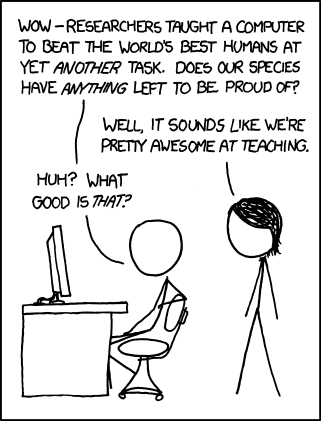
Comic on Teaching


Found this on the Shoebox blog (a tiny division of Hallmark). It's consistently entertaining and occasionally useful.

Thursday, September 23, 2010

Team-based Learning: ad campaign

I'm toying with a new idea for the team-based learning (TBL) unit of Comp 1. The lesson uses TBL methods and develops multi-modal composition skills by creating audio, video and static graphics. Last year I allowed greater student direction by letting groups choose their own products to develop. Where

This year I'm thinking of allowing students to take on authentic products and services. I've spoken with the director of the Writing Center here on campus, Kathryn Byrne, and she supports the idea of students promoting the WC, and would like several options to choose from because audio, video and/or promotional material created could be used in real promotion. That means student work could appear in podcasts, vidcasts and the student newspaper, and maybe even radio, TV and more public venues. Any student participation in a successful advertising campaign could be used in resumes as authentic work experience.

We have some material from past classes on the wiki here, a couple classes have used facebook - but that has limitations. See class Facebook group here, but the problem is they mostly created pages in private places that restricts sharing with future classes. Students have also posted video on YouTube here.

I like the idea that education creates a "walled garden" where students are safe to experiment and take risks - but sometimes we build a roof over the garden and ideas wither from lack of sunlight - or root rot. I'll figure out how to wrestle this analogy back to coherence later.

Wednesday, August 11, 2010

Andragogy - Teaching theory

Many education professors have recommended "A Teacher's Dozen" Fourteen General, research-based Principles for Improving Higher Learning in Our Classrooms by Thomas Angelo. You can find the PDF free here.

It might be more beneficial to require students to read it than to just share it with teachers. It is a succinct and brief treatise on what we know about learning - and since learning is more efficient when students have clear reasonable goals - and when their goals fit with the instructor - maybe it should be required reading. We need to discuss active learning and how it is superior to passive learning, and how that will affect the expectations in the class.

At any rate, my students will start by finishing these metaphors

  • "learning is ______________________________________"
and
  • "teaching is to learning as ___________________ is to __________________"

Monday, June 28, 2010

Zen and the Art of Cherry Picking.

Road trip to dad's to help out on the farm got me thinking about the fundamental interconnectedness of all things, and how picking cherries relates to teaching and learning writing.

1. The tendency for novice writers to "cherry pick" their data. It doesn't strengthen a writer's position to ignore data that may not agree with your a priori position (what you thought before you learned anything). Teachers want you to look around, become an expert and present a balanced look at the situation, then clearly define and articulate your position. Besides, rejecting too many choices shuts you off to possibilities and limits your experience.

2) "Bruised fruit can sometimes turn out to be the sweetest" (Grandma Dixon). It takes some experience to know what is and isn't useful, so don't be too picky and don't be afraid to benefit from collaboration and judgement of others. Someone else will be washing and pitting - they can help you when you have doubts - better to pick than to leave it on the tree. Just because an article doesn't look like it supports what you think your thesis will be - reading the article may provide ideas that will - or maybe your position will change to something easier to defend - which isn't necessarily bad. Some positions deserve to be changed. That's learning.

3) Going after low-hanging fruit is easy - but less rewarding than you might think. It's harder to find anything original that hasn't been consumed by anyone walking by if it's really easy to access. Like using wikipedia. It's low-hanging fruit: easy to access and generally thought to be up for grabs by anyone - but technically it does belong to the owners of the tree and or land it grows on. If it's community property then it isn't worth quoting. A little work will improve your experience exponentially. (needs work).

4) You think you've picked a spot clean - leave and come back and discover by looking at it from a different angle there's a lot you missed. Revisiting places you've been can be rewarding. Reread research - and search again using different terms and word choices.

5) It isn't about the cherries. My young son helped pick this year. He picked some bad cherries, he provided many distractions and kept my dad and I from being productive, and he on several occasions dumped perfectly good cherries into the grass for reasons that don't make sense to anyone over 3. But it wasn't just about the cherries. We could have bought the fruit at the market for less than what we spent on gas if that was it. He was learning. I was maybe teaching. Three generations of family were spending time together.

Wednesday, June 2, 2010

Feedback: teacher clarity and millennials

About every semester lately I get a request from a couple students for greater clarity in what is expected in a writing assignment. I expect this because the course goals and objectives of composition classes call for abstract thinking and problem solving. The course calls for me to challenge students with assignments that require them to find solutions, make decisions and discover and determine their own point of view.

But is this a facilitative tension required of any learning, or is it something else? A business publication asserts:
Unlike new hires of previous generations, who may have benefited from training in diversity or technical matters, experts say, millennials need other types of training--in professional behavior, for example, or in basic writing, confidentiality issues, critical thinking, or how to give and receive constructive criticism (emphasis mine).
The publication - and business leaders in general - targets writing as a key skill that young people lack - and further lists some of the top objectives in composition classes. For further articles see my bookmarks on millennials. Not all research agrees. Is conventional wisdom correct that youth are less prepared in these skills than past students?

Furthermore, the issue of professional behavior came up in a recent NPR piece. The story quoted Laura Wand, a director of Marketing at Johnson Controls:

"Dude, dress up. This isn't the mall," she tells the crowd.

With her PowerPoint slides, Wand tries to impart some helpful advice from the real world.

"Multitasking is a myth," she says. "You got a great job. Turn off the cell phone. Stop texting."

The cell phone issue is a frequent topic among teachers.

Students who have never gotten constructive criticism - or who have never been allowed to fail - are less persistent, but there have always been students like that. I remember a student in 2009 who couldn't figure out the metaphor paper and then dropped out of class for a few weeks. He came back and explained that when he gets frustrated, he simply quits.

I feel like if any of my students aren't frustrated by an assignment - then it isn't challenging enough. Optimizing student learning may make me less popular. Higher Ed Morning reports that 45% of students are using online professor rating web sites - and that these sites say whether teachers are "easy grading." If this is a criteria by which students select teachers - how will it affect learning and how will it affect my evaluations?

Monday, April 19, 2010

Lessons from Master Teachers

At the KCPDC Master Teacher Retreat this year, 20 of the best teachers from colleges in the KC metropolitan area generated a list of axioms or teaching truths: philosophy they teach by, such as:
  • Teachers should violate expectations of the students (regarding bad, or no longer appropriate, andragogy).
  • Teaching isn't talking, and learning isn't listening. Good teachers don't tell their students what to do, but engage in a conversation about learning.
  • Bad teaching is answering questions that haven't been answered
  • Teachers have to be authentic or transparent in their motives and goals. This means having discussions about pedagogy/ andragogy.
We further discussed the importance of talking to students about striking the right balance between: home, work, school and health.

Monday, June 29, 2009

New Open

China and Chinese speaking countries will be the largest English speaking populations within a few years. How new users impact the language interests me. While living in Taiwan I noticed "New Open" used the way we in the states use "Grand Opening." The Chinglish version is more succinct and communicates the same information - even communicates it better to non-native English speakers (NNS) than the idiomatic phrase that sounds right to locals of these united states. The language likes economy of word use.

Welcome to my JCCC writing blog Grand Opening. This blog will share educational philosophy, (aka pedagogy, or the more correct but more easily misunderstood andragogy (no that has nothing to do with androids)), as well as resources for students of composition.

Goal: to post content of use to composition students using multiple modes of expression.

And a bit of trivia: I changed the title because I couldn't decide if the title should read "as clearly as possible," or "as clear(ly) as possible"?

For original source of these cartoons go to http://xkcd.com/