Showing posts with label grammar. Show all posts

Wednesday, March 9, 2011

in-text citation - ellipsis

Ellipsis (plural ellipses) deserve some discussion. Check out the following sources:
In prose, ellipses are not generally needed at the beginning or end of a quote. The rule is different for poetry - and if there is confusion between the above sources - my rule is no ellipsis at the beginning or end of a quote. Even if you end a quote before the period. Even if the first part of the sentence is left off.

MLA has gone back and forth on whether brackets [...] are needed to clarify that you inserted ellipsis rather than include punctuation found in the original source - so that one is you call. Just be consistent.

Tuesday, March 8, 2011

Semicolons and colons

One of the punctuation issues that recurr most often involves the use of semicolons. This matters because - the way a semicolon functions - if one uses a semicolon where a comma or colon are needed, it creates a sentence fragment, which is a grammatical misdeed of the most heinous order.

I like semicolons and don't want to discourage their use - so check out the Oatmeal's humorous exploration of semicolons - they have the grammar right.

Also, check out a less funny but equally useful comparison contrast explanation of semicolons vs. colons at Xavier University's Writing Center website.

Wednesday, November 3, 2010

Grammar in the news.

Even without a taser, a bear can be dangerous. Do you really think those fangs and claws are for eating berries?

Thanks to The fail blog.

Wednesday, October 13, 2010

Scare quotes are Evil

As written earlier
I'm seeing too "many" superfluous quotes. Wikipedia calls this Scare Quotes. Avoid this. I don't like irony conveyed through quotation marks. Use words. And they don't work for emphasis. Serious explanation here. Check out the blog dedicated to unnecessary quotes here - or the Facebook group - seriously.

Sunday, October 3, 2010

What I'm Learning from the SRTOL Essays: FA2010

  • I want students to get away from the idea of correct or incorrect grammar. This thinking indicates a prescriptive rather than descriptive definition of grammar - and runs counter to the goal of the assignment; however, if someone really wants to go there - plan on defining grammar in detail.
  • So many thesis statements ended up on the last page. I specifically asked for them in the first paragraph, and in 85% or more of published essays that's where you find them. It makes reading easier and more predictable. Someone this semester asked if they could put the thesis on the last page. I said they could, but that doesn't mean one should. In every case so far where I find the thesis after the first 2 paragraphs it looks like the author wrote until they discovered the thesis then quit when they hit minimum length requirements: typical first draft stuff. They generally should have then moved the thesis to the first paragraph, and then pruned the essay down to just what is relevant or implied by the thesis. Then add support and detail to what's left.
  • I'm seeing too "many" superfluous quotes. Wikipedia calls this Scare Quotes. Avoid this. I don't like irony conveyed through quotation marks. Use words. And they don't work for emphasis. Serious explanation here. Check out the blog dedicated to unnecessary quotes here - or the Facebook group - seriously.
  • Cliche alert - avoid "in today's society."
  • Regarding format specifications. Ignoring format requests is antisocial and passive aggressive.
  • Overly wordy introductions to quotes - transitions are needed - but empty and redundant information isn't. I repeatedly see, "In the journal article __________ published in ______ by the author _______ it says..." All this information is on the works consulted page - right? So a shorter reference will work. The wordy version makes it almost an appeal to authority. "Smith argues, "Blah, blah, blah" will work just as well. Or "Blah, blah, blah"(Smith 45).
  • EVERY SOURCE USED OR MENTIONED SHOWS UP ON THE WORKS PAGE! This is a big deal. Just because I may know of the article, doesn't mean you're excused from citing the source. We need to demonstrate the ability to work with sources. That's a huge objective of this class.
  • "some people say" is a red flag for a specious argument and a need for more research and support.


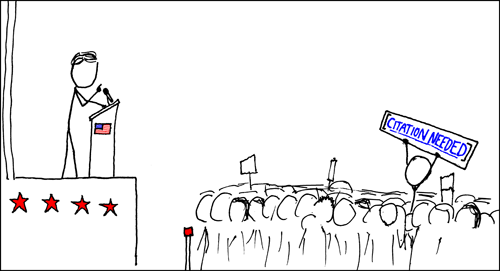
http://imgs.xkcd.com/comics/wikipedian_protester.png

Sunday, September 26, 2010

Grammar Matter (?): that vs who

One mechanical or stylistic pet peeves that got violated most in the SP2010 semester is the careless or inconsistent use of that vs. who. These words (along with "which") introduce a type of relative clause, which is particularly difficult for speakers of Asian languages - because relative clauses don't exist in their native tongues. Relative clauses are only found in European languages (tho some Native American languages have adopted the grammatical structure due to the influence of Spanish). But the "That/ who" distinction discussed here is a primarily native-English speaker issue. This concern is shared by many of my colleagues, and this issue sparked the longest dialogue posted to a teaching list-serv this year. Consider some examples. A colleague posted the following, and asked us to compare:
She was a student that worried about the finer points.

To this:

She was a student who worried about the finer points.

It's small and fussy, but in my ear it's like calling a person "it."

I whole-heartedly agree. "That" is way overused - and it denies humanity to the word it refers to - its antecedent. It reminds me of a self-described " conservative Christian" who referred to "children that are abused." Denying humanity to a race or class of people is the first step to violence against that group: the irony. Another prof. here offered:
I agree that it's most important just to get students thinking about word choices. It's pretty common, though, for personalized animals, like pets, to be referred to as "who." However, I too prefer students to refer to people with "who," even when the student wants to write "the damn cop that gave me the ticket!"
Grammar Girl weighs in on the subject with her customary verve here. And Grammarbook.com is less equivocal and more succinct.

What I'm learning: pronouns

We expect to see a lot of lower scores on the "distinct sentences" portion of the Microlab, but many students this semester lamented low scores in "misplaced modifiers" and "pronouns." Several students had already seen comments on their papers about "dangling" or misplaced modifiers, but there seems to be a general confusion about the pronouns category.

It makes sense for me, if the Microlab looks at relative pronouns. I've been expressing concern about that ;) for at least the last year. Purdue's Online Writing Center explains it fairly well, but I may prefer wikipedia - because the table on the OWL site may seem to imply that "that" can be used to refer to people. I have an issue with that. For example here's a quote from the 9/20/10 US magazine "Loose Talk" section - where they provide quotes from celebs.
It's nice to be one of the guys that can help sell a movie by taking his shirt off, [but] by no means do I want to be a piece of meat for the rest of my career (Lutz 34 - emphasis mine).
This is funny! The use of "that" rather than "who" as a relative pronoun choice denies himself the humanity he claims to eventually want. He treats himself as an inanimate object, implying linguistically that he is, after all, just "a piece of meat." Is there anything wrong with that?

Purdue would say he can to that he can do that (but not necessarily that he should) - but almost every other style book frowns seriously on using "that" when "who" traditionally would be called for. To me in this instance it seems imprecise and undercuts Kellan's argument that he should be eventually taken seriously. Unless one is referring to work as a meat puppet (Philip K. Dick reference - not necessarily the punk band) one should not use "that" to refer to a human.

Does anyone remember the trouble President Clinton got into for a reference to "that woman"?

Tuesday, September 14, 2010

The Royal Order of Adjectives..

I found this graphic at http://grammar.ccc.commnet.edu/grammar/adjectives.htm Thanks to Chad for the head's up.

It illustrates what we spoke about in class - native speakers intuitively understand but Non-native speakers have to learn.

Wednesday, August 11, 2010

What not to say to your prof

These were collected by a colleague of mine, David Davis. They do have a way of getting under a composition instructor's skin - tho I said at least 1 of 'em as an undergrad.

10 things to avoid saying to your professor
  1. "You know what I mean."
  2. "I really need an A" (B, C, whatever).
  3. "I have a friend who is an English major and he said..."
  4. "In high school I always got As" (Bs, whatever).
  5. "I really worked hard on this." / "I put a lot of effort into this."
  6. "Well, that's just the way I write."
  7. "I wasn't in class; did I miss anything?"
  8. "I couldn't get the assignment done because I had a big test in another class."
  9. "Well, I don't think comma splices (organization, topic sentences, following directions, whatever) should be worth that many points."
  10. Passing the buck: "My boyfriend/girlfriend was supposed to put my paper in your mailbox" / "My cable provider has really unreliable internet service" / "The drop box is really hard to understand" / etc.
For the entire list together as David wrote it, with his trenchant and entertaining explanations.

My classes will have to explain why students say these things, and imagine how an instructor will react. Maybe we'll do a role-play.

Monday, July 5, 2010

In America, there are no small eggs.

We do something illogical with in American culture regarding our language used to describe sizes. An Ivy League educated linguist I worked for in Taiwan used to ponder about this, and ask me, "Why, in America, don't you have small eggs? Some recipes call for one or two small eggs, but the grocery stores only carry medium, large, extra large and jumbo. What happened to the small eggs?"

She wasn't a native English speaker - but she was a citizen and she lived in the states about 20 years, raised a couple native English speakers, and held advanced degrees (including a PhD) in English language and linguistics. This issue seriously intrigued her and has been on my mind for well over a decade.

The issue may be fairly recent. My grandparents (both born before the 1920's here in the US) insisted on buying small minnows for crappie fishing because even larger fish may prefer a small bait. I remember buying small minnows. I defy you to go into any bait store today and find small minnows.

I just ordered a small chicken noodle soup for my toddler at a chain restaurant. The clerk was so concerned, "Oh my. I'm sorry. We only have medium and large." His concern touched me, but isn't medium half-way between to extremes - small and large. How is it logically possible to have only two sizes and one of them is medium?

The descriptive linguist in me speculates that these words have become homonyms of themselves - in effect a sort of headless noun. Medium is a proper name for a choice - not a description of a size. So I said, "Oh, you mean "Medium" with a capital 'M', I meant small with a lower-case 's'"... which caused him to just stop talking and give me the soup - which btw came in a cup not much bigger than a thimble.

Or is it a popular/cultural fetish that equates large with good and small with inferior? This isn't always so. Small vegetables often have a better texture and flavor - and fine restaurants prefer them. btw - I grew up eating baseball bat sized zuccini - but they should be picked at 6-8 inches or smaller. I worked on a commercial vegetable farm that supplied some of the finest cafe's on the plaza and had the chance to talk with some chefs.

If anyone has insight - or similar experiences - or an opinion re: my linguistic theory, please weigh in.

And yes, I know Pinker uses "headless nouns" almost exclusively to discuss idiosyncratic pluralization - but that doesn't mean the phenomena is restricted to that context. If you have an equally viable explanation share. A comedian could have fun with this coming at it from a cultural perspective.

Thursday, June 3, 2010

Grammar matters (?): #9 farther vs. further.

Farther is distance and further is for an abstract concept - matter of time or degree usually. Click on cartoon for full treatment (it won't fit here and be legible).

Wednesday, June 2, 2010

Grammar matters (?)

Oddly enough - non-standard grammar / spelling bother most people even more than it bothers English teachers. English teachers just see so much of it; however, nothing makes people feel more superior than reading someone else's mistakes.

Failure to proofread is anti-social and indicates a lack of respect for the reader and whoever wrote it.

Sunday, May 23, 2010

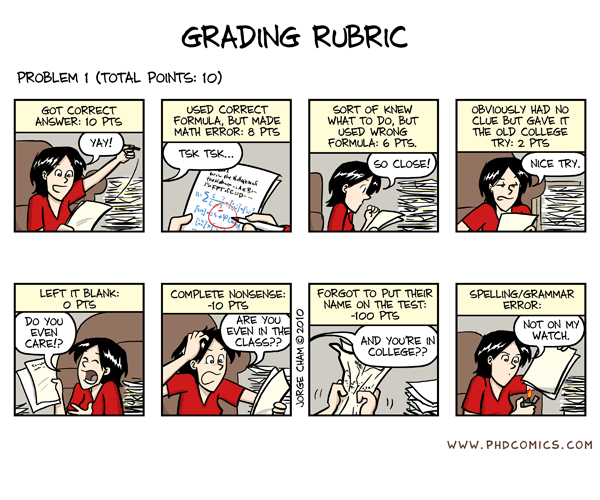
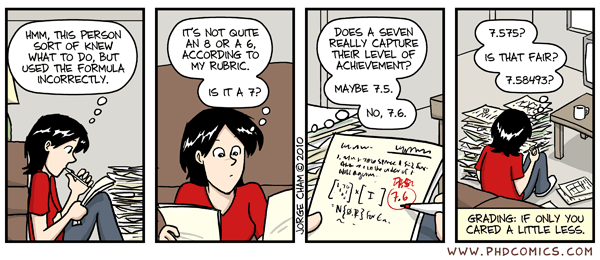
Grading papers

I don't enjoy figuring grades. I'm a score keeper - I don't "give grades," but the truth is I want people to get good grades. I can not reward those who ignore the assignment prompt though, and it's hard not to get a little annoyed when someone does those little things I've harped on all semester, like:
  • misuse block quotes - in format please - otherwise it's mondo confusing.
  • display obliviousness to the "that vs. who" distinction. If you're referring to a human, use who. "That" implies a thing (or maybe a non-sentient animal?). See Grammar Girl for elaboration.
  • ignore minimum page lengths. They are there for a reason. Many teachers will simply fail any paper that comes up short. Maybe that's what I need to do.

Tuesday, March 2, 2010

15 things you don't know about me

  1. I cook. I like it and I'm pretty good at it.
  2. I do all the laundry at my house.
  3. I'm also the first to change dirty diapers - provided my son dirtied them.
  4. I taught kindergarten for a year.
  5. I wrestled varsity in college. Lettered 3 years.
  6. I thought I might be an atheist from age 14 to about 28 - but it turned out I was just stuck in a very bad mood.
  7. I've worked on farms much of my life - and can drive a tractor pretty well.
  8. I like traveling and have visited at least 9 countries.
  9. When traveling, I eat all the weird foods. Few people have eaten things I haven't tried.
  10. My primary mode of transportation for about 3 years was a motorcycle.
  11. I've broken at least 5 distinct large bones not counting noses, toes, fingers/thumbs, or ribs. Too many of those to count.
  12. Television can hypnotize me - I won't touch a remote control unless I'm completely alone.
  13. I can read on a bus, in a full sporting auditorium during a competition, during a riot, etc.
  14. I speak ( or at least spoke) passably fluent Mandarin Chinese.
  15. When I worked in a convenience store I sold cigarettes and beer to pregnant women (not exclusively or even most of the time - but I remember it because it bothered me).
  16. I played nose guard in 4A High School football. We won league and made it to state semi-finals. I was all league. I weighed 153 lbs dripping wet at the time.
  17. I went to a catholic grade school.

Monday, March 1, 2010

Microlab Spring 2010

A student set a new high for my classes in the Microlab this semester: 86. Last year one person scored a 78. I've learned that the Writing Center tutors told us the scores average around 52%. Several students told me they thought the failed because they scored under 60% when they were actually above average.

I noticed too many people being really hard on themselves because of the score. It's just one assessment. Don't put too much stock in any one assessment, be it a computer test or a teacher. Listen to what they have to say and figure out what they mean. Pay attention to themes or recurring messages.

OR maybe people beat themselves up excessively in a sort of passive aggressive protest? If so, touche.

Several this time around pointed out issues with the font. That bothered a lot of people. Also that you can't go back and change things. Why might that be intentional?

This is meant to be a snapshot - one imperfect but relatively objective measure.

I wonder if in some ways it is like weighing one's self. Just because you weigh yourself more often doesn't make you lose weight faster. It doesn't work that way for me anyway - I tend to weigh myself multiple times a day. But owning a scale and checking does seem to help.

Can/ should I discuss results (ie performance of NNS/ by race/ gender/ origin?)

Friday, February 19, 2010

All grammar and style advice should be funny

Fake APStylebook posts style advice for writing - the site makes me laugh consistently and sometimes I agree with their point. Sometimes it's bogus - but generally funny. attached is a screengrab from what I found worthy of retweeting (BTW: follow me here on twitter if enough people did I might actually keep up with it).

I decided to follow them on the advice of a student who gets updates to his cell phone.

This reminds me somewhat of The Transitive Vampire - a grammar handbook for the doomed. It actually does a great job teaching grammar - on purpose.

Thursday, February 11, 2010

Passive voice

When I speak of excessive use of passive voice (or passive verbs) I refer to the over use of "to be" verbs: is, are, was, were, be, being, been and am.

Passive verbs are to writing what salt is to the American diet. The human body needs salt- and if and when it is totally eliminated from a person's diet that person will eventually die. But we tend to eat way too much salt. It's everywhere! It has become a health problem that leads to health problems and the early death of too many people (fat works in the metaphor too).

Same with passive verbs. Good writing will have a few - but first drafts always have too many - and with some students I only see first drafts. We have to learn to reduce our reliance on passives.

Passives
  • can make sentences longer than they need to be - resulting in wordy constructions
  • hide or obscure agency - who did what? Politicians have long used passives for non-apologies for various heinous acts
  • suck the life out of writing. Active verbs have more ... action. Stuff happens.
  • were once tacitly, if not explicitly, encouraged in medical schools. In 2006, my boss at the KU Med Writing Center showed me research that indicates this habit - with the intent to hide agency in case of malpractice cases - actually exacerbates the filing of malpractice suits. Modern med schools now, at least publicly and officially, no longer encourage passive voice in medical reports (eg. "the patient's temperature was 106" is now better, "the nurse recorded the patients temperature at 106" ).
Sometimes the problem may come from cognitive malware installed by previous writing instructors, such as directives "Don't use first person in any writing!" in which the teacher probably meant to address other issues such as wordiness and over-reliance on opinion rather than fact or support. I don't mind an occasional use of first person - especially if it reduces passive verbs. But that's just me ;)

There's an online interactive tutorial from punctilious.org that we should use in class. I've also started collecting links re: passive voice/ passive verbs on the social bookmarking site.

Monday, February 8, 2010

Response to Comp 2 literacy reflection.

This term's Literacy Reflections impress me. We have some bright and thoughtful classmates. I'd like to note that for the first time in my almost-2-decade career in higher ed. about 90% of the class got the MLA heading right! What happened? I've never seen more that 30% get the heading even close on the first paper. I 'm verklempt.

Then, as is too often the wont of composition instructors, I get distracted by less than optimal usage and rhetoric. Too often it looks like students merely type rather than compose their papers. Most often, waiting until the last minute and rushing through a paper, then neglecting to proofread causes this. This may be the root cause of the following:
  • over-use of passive verbs: while it didn't affect the grade on this paper, excessive use of passive voice will be considered in all subsequent papers. Passive voice is the "to be" verbs: is, are, was, were, be, being, been, am.
  • passive language occasionally betrays a lack of responsibility or involvement with the educational process in expressions such as, "I received _(good/bad)_ grades in high school." Didn't you earn them? If they were unfair didn't someone give them to you? Also seen repeatedly, "the classes I was enrolled in." Did the student have a choice? Was there parental or institutional pressures that aren't being directly communicated? Passive verbs hide agency - the "who was responsible for what"ness of good writing.
  • use of semicolons (;)Technically it acts like a period - which means it should be followed by an independent clause. Too often fragments (dependent clauses_) follow. If that's the case use a colon (:) or comma. Really a trivial issue - but I'm glad to see people using semi-colons and I want to see them used correctly, so as not to diminish their effect.
  • 5 paragraph essay - legit for this assignment but overused. Be willing to try new and more sophisticated forms of organization.
  • Conclusions not summaries. Summaries come across too often as redundant.I know someone somewhere once said, "Tell 'em what you're going to tell 'em. Tell 'em. Tell 'em what you've told them" but that was an oversimplification and/or questionable advice. I read quite well and remember what I've read. I expect more nuanced and sophisticated rhetoric (congrats to AH for being the first to use the word in class).
Several writers appear to have gone down the list of possible ideas to respond to found in the assignment prompt, and then addressed them one at a time in that order with little or no attention to transitions or organization, rather than adjusting the suggestions to the individual student's experience and crafting a coherent approach to organization. (Wow that was a long sentence).

These issues commonly, if not always, appear early in a semester. Let me reiterate that the content and reflection was exceptionally good.

Thursday, February 4, 2010

The gravity of punctuation.

Punctuation sometimes makes a huge difference. Today on BoingBoing a great dialogue rages on regarding the dangers of careless punctuation. I dream of the day when I get dialogue like that on one of my blogs. But be warned - at least one comment is off color.

The first comment correctly punctuated is wholesome, but the slightest slip and it implies something obscene. Examples like that illustrate the richness and the fun of language, and could forestall embarrassing mistakes by students, but could a discussion like that get me in trouble?

Punctuation has real world implications - for example the time conservative California judges had to allow same-sex marriage because the lawmakers who passed legislation against it misplaced a semicolon.

My question, can and should we have these discussions? What is acceptable language? Is it about topics, ideas, or merely about word choices? Many students this semester go to church regularly and characterize themselves as devout. How (or should) we filter dialogue?

I went to catholic school 6 yrs., and have taught in at least 2 church colleges/universities. Religious schools counter-intuitively allow discussions that might get a teacher in trouble at a public institution. What's the consensus with our group(s)?

Thursday, December 31, 2009

Awesome grammar lesson /find from "The Oatmeal"


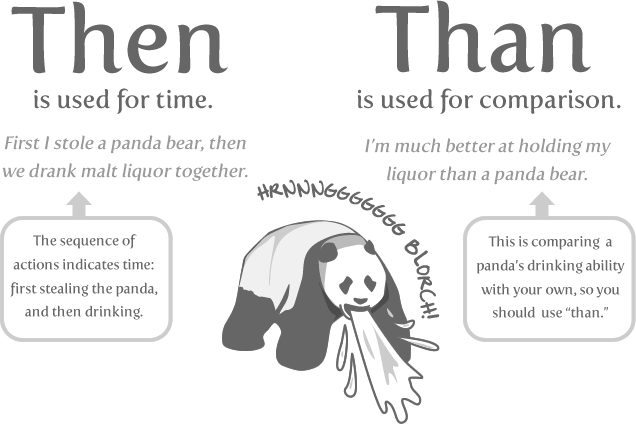
Double click to see images larger. Find the complete interactive digital artwork at their website which includes common mechanical errors with fun, accessible, explanations. I embedded a few such as one of my pet peeves:


and here's another common error.