Showing posts with label learning. Show all posts

Thursday, October 28, 2010

corporal punishment

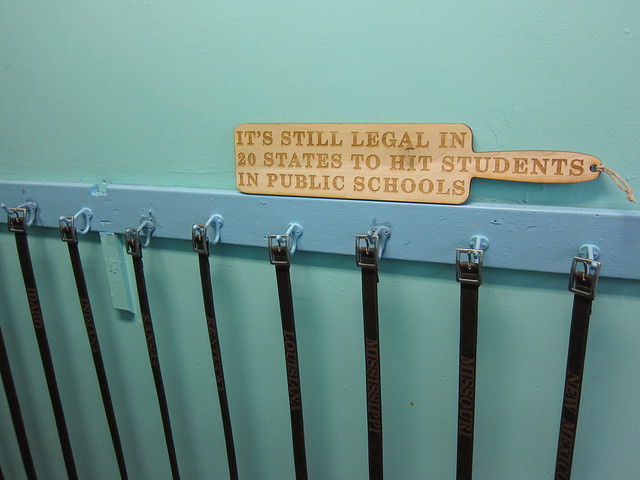
Photo courtesy of The Laughing Squid. I see Kansas represents in the negative reinforcement (and Missouri - click to enlarge image - we are next to Kentucky).

So let me get this clear, it's legal to hit students in Kansas? Seems like we don't see the difference between education and learning.

Friday, June 25, 2010

What can you learn thru Read/Write web; what skills are needed (research notes)

Luckin et al. (2009) asks how the read/write web interacts with learning and what sort of skills support the kind of learning that happens in this environment, and notes that researchers (Buckingham, 2007; Green and Hannon, 2007; Jenkins, 2006) have identified "learner criticality" as a constellation of essential cognitive skills. I'll have to read up on these sources to be sure of how the term is used, but it seems to be a more specific subset of meta-cognitive skills - which is an awareness and knowledge of self and learning - learning to learn.

Luckin et al's study of 11-16 year old British students found low use of wiki's (save for Wikipedia), blogs and podcasts by students, and high use of social networking sites, such as Facebook. The tremendous potential of the former applications are not as embraced by youth as we might have thought. Indeed, they found,
The types of activity revealed by the data illustrated little evidence of critical enquiry or analytical awareness, few examples of collaborative knowledge construction, and little production or publishing outside social networking sites. We also confirm the low level of computer activity at school when compared to use at home and also illustrate the difference in the type of activity being undertaken inside and outside school (100).
Luckin et al. also note a lack of sophistication in research and a lack of higher order thinking skills. We should remember that the population studied were only 11-16 years old, but elsewhere Carr (2010) argues that modern technology creates consumers of information who are less equipped to think deeply or construct meaning from that information.

Works Cited
  • Buckingham, D. 2007. Beyond technology: Children’s learning in the age of digital culture. Cambridge: Polity.
  • Carr, N. 2010. The Shallows Norton & Co.
  • Green, H., and C. Hannon. 2007. Their space: Education for a digital generation. London: Demos.
  • Jenkins, H., K. Clinton, R. Purushotma, A. Robison, and M. Weigel. 2006. Confronting the
    challenges of participatory culture: Media education for the 21st century. Chicago:
    MacArthur Foundation.
  • Lenhart, A., and M. Madden. (2005). Teen content creators and consumers. Washington, DC: Pew Internet & American Life Project.
  • Luckin, R. et al. (2009)"Do Web 2.0 tools really open the door to learning? Practices, perceptions and profiles of 11–16-year-old students" Learning, Media and Technology. 34 ( 2) 87–104
Thursday, June 24, 2010

Are students technology experts?

While there is no shortage of people with the view that today's young are fish, and social media and technology are the water through which they swim, that isn't the complete truth.
  • Pew Reports note that young people are prolific creators and consumers of online content (Lenhart and Madden, 2005),
  • O'Brien and Fitzgerald (2006) discuss their propensity to create and remix video and music,
  • Lankshear and Knobel (2005) establish the popularity of writing blogs among the youth community
However, there is ample evidence that while this is true for some students, it is true of a minority of students and the majority are not especially tech savvy (Luckin et al., 2009; Green and Hannon, 2007). For most they can access content but do not create it.

Some of my students have written comments in their literacy narratives that echo this common assumption of universal technological skill, such as, "I was born in the technological age, so of course I'm good with all sorts of computer applications." [paraphrase]. But invariably I find that most students are unaware of many basic skills necessary for managing the online Learning Management System (ANGEL), and using and commenting on blogs, wikis and youtube. There are always many students who teach me things I didn't know, and a small few who seem to know more about the medium than I.

This has proven true at the 3 schools I've taught at since I started paying attention to the question - and includes both University and Community College students. A focus group I conducted back in 2008 indicated interest in a "technology boot camp" or intensive workshop in educational technology necessary for student success.

I have a feeling the responsibility for such learning-to-learn-with-technology will fall on teachers of gateway classes - in particular those of us who teach composition.


Works cited

Green, H., and C. Hannon. 2007. Their space: Education for a digital generation. London: Demos.
Lankshear, C., and M. Knobel. 2006. Weblog worlds and constructions of effective and powerful writing: Cross with care and only where signs permit. In Travel notes from the new literacy studies: Instances of practice, ed. K. Pahl and J. Roswell, 72–94. Clevedon: Multilingual Matters.
Lenhart, A., and M. Madden. (2005). Teen content creators and consumers. Washington, DC: Pew Internet & American Life Project.
Luckin, R. et al. (2009)"Do Web 2.0 tools really open the door to learning? Practices, perceptions and profiles of 11–16-year-old students" Learning, Media and Technology. 34 ( 2) 87–104

Sunday, June 20, 2010

Secrets of other teachers.

Tweed, a blog by the Chronicle of Education, has an interesting example of teachers who should know better having no privacy settings and posting inappropriate (?) comments on Facebook.

This isn't how I grade because a) I don't drink beer when I grade (tho I abuse coffee), and b) every paper gets read about 3 times; however, what the third comment down says about how - by the last 10 papers - if students use the right format and write coherently - they get an "A" does resonate. I suspect it's true of MANY teachers - and that's why up to 10% of a paper grade goes for MLA format INCLUDING/ ESPECIALLY THE HEADING and page #'s.

If you get an "A" in my class you learn to work the academic system - how to play the college game. And format is part of the objectives for all comp classes. AND it is SO EASY!

Tuesday, June 1, 2010

advice to myself - what I'll do differently next semester

We will
  1. establish the role of wikipedia (ie. anything there should be considered common knowledge, so it doesn't make an effective quote in a real research paper - but can make useful footnotes for electronic discussions).
  2. likewise: queries to ask.com or about.com can be a useful place to start a personal journey of discovery - but are ineffective citations in a respectable essay. These sources function more as an appeal to an authority than legitimate research - and the authority is a search engine.
  3. dedicate more class time earlier to the iSearch, and discuss cognitive biases and credibility earlier - making ourselves accountable. We still see too much cherry picking and insubstantial research.
  4. restrict ourselves to documents and data available through the Billington Library or through the internet without fee or registration - so anyone can track down other people's data.
  5. increase the penalty for papers that fall short of minimum length requirements.
  6. consider increasing the amount of points given/ received by peers. Classmates are amazingly accurate in peer assessments.

I also need to share more learning styles/ life skills content early on. NEED TO COVER IN CLASS "How college is different from High School."

Also, here's an interesting and counter-intuitive video from Stephen Fry on "what I wish I'd known when I was 18." Not sure I agree with all of it - but he makes some good points.

Saturday, January 2, 2010