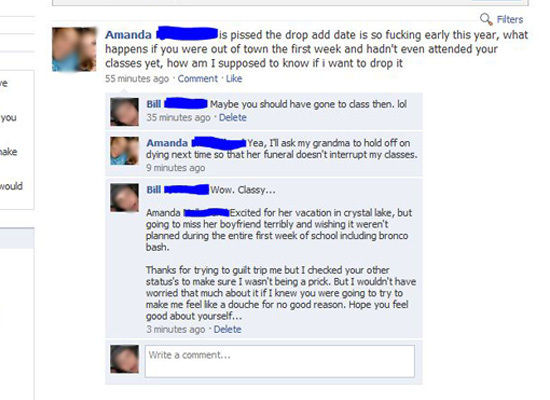
 Got this from a post on the funniest facebook fails, but something very much like it has happened with one of my students.
Showing posts with label lifehack. Show all posts
Showing posts with label lifehack. Show all posts
Sunday, August 7, 2011
Funny because it's true...
Got this from a post on the funniest facebook fails, but something very much like it has happened with one of my students.

Wednesday, March 2, 2011
Technology expectations in the classroom
Had a couple students balk at using the Learning Management System - and even computers in general - in an English class. Teaching writing has always been about teaching technology, and inventions from the printing press to the typewriter and word processor have redefined our writing processes.
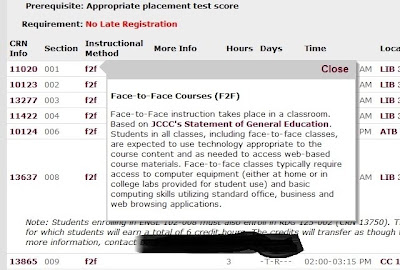 You get to this by going to the school website> enroll> Search class schedule>then enter “English> as a search term> then hover over f2f (face to face). It may be for all classes on campus - but I know it works with any English class.
Click the image to see it larger - and I'll reproduce the text below:

 You get to this by going to the school website> enroll> Search class schedule>then enter “English> as a search term> then hover over f2f (face to face). It may be for all classes on campus - but I know it works with any English class.
 Click the image to see it larger - and I'll reproduce the text below:
When students enroll, they agree these conditions - but they may not be aware of it.Face-to-Face Courses (F2F)
Face-to-Face instruction takes place in a classroom. Based on JCCC's Statement of General Education. Students in all classes, including face-to-face classes, are expected to use technology appropriate to the course content and as needed to access web-based course materials. Face-to-face classes typically require access to computer equipment (either at home or in college labs provided for student use) and basic computing skills utilizing standard office, business and web browsing applications.
Wednesday, August 11, 2010
What not to say to your prof
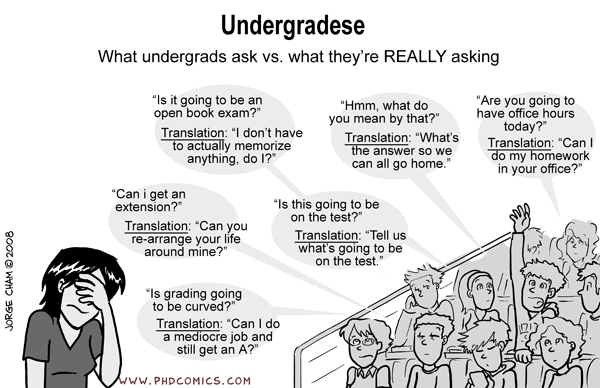
These were collected by a colleague of mine, David Davis. They do have a way of getting under a composition instructor's skin - tho I said at least 1 of 'em as an undergrad.
My classes will have to explain why students say these things, and imagine how an instructor will react. Maybe we'll do a role-play.
10 things to avoid saying to your professor
- "You know what I mean."
- "I really need an A" (B, C, whatever).
- "I have a friend who is an English major and he said..."
- "In high school I always got As" (Bs, whatever).
- "I really worked hard on this." / "I put a lot of effort into this."
- "Well, that's just the way I write."
- "I wasn't in class; did I miss anything?"
- "I couldn't get the assignment done because I had a big test in another class."
- "Well, I don't think comma splices (organization, topic sentences, following directions, whatever) should be worth that many points."
- Passing the buck: "My boyfriend/girlfriend was supposed to put my paper in your mailbox" / "My cable provider has really unreliable internet service" / "The drop box is really hard to understand" / etc.
My classes will have to explain why students say these things, and imagine how an instructor will react. Maybe we'll do a role-play.
Thursday, July 1, 2010
Thursday, June 24, 2010
Are students technology experts?
While there is no shortage of people with the view that today's young are fish, and social media and technology are the water through which they swim, that isn't the complete truth.
Some of my students have written comments in their literacy narratives that echo this common assumption of universal technological skill, such as, "I was born in the technological age, so of course I'm good with all sorts of computer applications." [paraphrase]. But invariably I find that most students are unaware of many basic skills necessary for managing the online Learning Management System (ANGEL), and using and commenting on blogs, wikis and youtube. There are always many students who teach me things I didn't know, and a small few who seem to know more about the medium than I.
This has proven true at the 3 schools I've taught at since I started paying attention to the question - and includes both University and Community College students. A focus group I conducted back in 2008 indicated interest in a "technology boot camp" or intensive workshop in educational technology necessary for student success.
I have a feeling the responsibility for such learning-to-learn-with-technology will fall on teachers of gateway classes - in particular those of us who teach composition.
Green, H., and C. Hannon. 2007. Their space: Education for a digital generation. London: Demos.
Lankshear, C., and M. Knobel. 2006. Weblog worlds and constructions of effective and powerful writing: Cross with care and only where signs permit. In Travel notes from the new literacy studies: Instances of practice, ed. K. Pahl and J. Roswell, 72–94. Clevedon: Multilingual Matters.
Lenhart, A., and M. Madden. (2005). Teen content creators and consumers. Washington, DC: Pew Internet & American Life Project.
Luckin, R. et al. (2009)"Do Web 2.0 tools really open the door to learning? Practices, perceptions and profiles of 11–16-year-old students" Learning, Media and Technology. 34 ( 2) 87–104
- Pew Reports note that young people are prolific creators and consumers of online content (Lenhart and Madden, 2005),
- O'Brien and Fitzgerald (2006) discuss their propensity to create and remix video and music,
- Lankshear and Knobel (2005) establish the popularity of writing blogs among the youth community
Some of my students have written comments in their literacy narratives that echo this common assumption of universal technological skill, such as, "I was born in the technological age, so of course I'm good with all sorts of computer applications." [paraphrase]. But invariably I find that most students are unaware of many basic skills necessary for managing the online Learning Management System (ANGEL), and using and commenting on blogs, wikis and youtube. There are always many students who teach me things I didn't know, and a small few who seem to know more about the medium than I.
This has proven true at the 3 schools I've taught at since I started paying attention to the question - and includes both University and Community College students. A focus group I conducted back in 2008 indicated interest in a "technology boot camp" or intensive workshop in educational technology necessary for student success.
I have a feeling the responsibility for such learning-to-learn-with-technology will fall on teachers of gateway classes - in particular those of us who teach composition.
Works cited
Green, H., and C. Hannon. 2007. Their space: Education for a digital generation. London: Demos.
Lankshear, C., and M. Knobel. 2006. Weblog worlds and constructions of effective and powerful writing: Cross with care and only where signs permit. In Travel notes from the new literacy studies: Instances of practice, ed. K. Pahl and J. Roswell, 72–94. Clevedon: Multilingual Matters.
Lenhart, A., and M. Madden. (2005). Teen content creators and consumers. Washington, DC: Pew Internet & American Life Project.
Luckin, R. et al. (2009)"Do Web 2.0 tools really open the door to learning? Practices, perceptions and profiles of 11–16-year-old students" Learning, Media and Technology. 34 ( 2) 87–104
Sunday, June 20, 2010
Secrets of other teachers.
Tweed, a blog by the Chronicle of Education, has an interesting example of teachers who should know better having no privacy settings and posting inappropriate (?) comments on Facebook.
This isn't how I grade because a) I don't drink beer when I grade (tho I abuse coffee), and b) every paper gets read about 3 times; however, what the third comment down says about how - by the last 10 papers - if students use the right format and write coherently - they get an "A" does resonate. I suspect it's true of MANY teachers - and that's why up to 10% of a paper grade goes for MLA format INCLUDING/ ESPECIALLY THE HEADING and page #'s.
If you get an "A" in my class you learn to work the academic system - how to play the college game. And format is part of the objectives for all comp classes. AND it is SO EASY!
This isn't how I grade because a) I don't drink beer when I grade (tho I abuse coffee), and b) every paper gets read about 3 times; however, what the third comment down says about how - by the last 10 papers - if students use the right format and write coherently - they get an "A" does resonate. I suspect it's true of MANY teachers - and that's why up to 10% of a paper grade goes for MLA format INCLUDING/ ESPECIALLY THE HEADING and page #'s.
If you get an "A" in my class you learn to work the academic system - how to play the college game. And format is part of the objectives for all comp classes. AND it is SO EASY!
Subscribe to:
Posts (Atom)