Showing posts with label punctuation. Show all posts

Wednesday, March 9, 2011

in-text citation - ellipsis

Ellipsis (plural ellipses) deserve some discussion. Check out the following sources:
In prose, ellipses are not generally needed at the beginning or end of a quote. The rule is different for poetry - and if there is confusion between the above sources - my rule is no ellipsis at the beginning or end of a quote. Even if you end a quote before the period. Even if the first part of the sentence is left off.

MLA has gone back and forth on whether brackets [...] are needed to clarify that you inserted ellipsis rather than include punctuation found in the original source - so that one is you call. Just be consistent.

Tuesday, March 8, 2011

Semicolons and colons

One of the punctuation issues that recurr most often involves the use of semicolons. This matters because - the way a semicolon functions - if one uses a semicolon where a comma or colon are needed, it creates a sentence fragment, which is a grammatical misdeed of the most heinous order.

I like semicolons and don't want to discourage their use - so check out the Oatmeal's humorous exploration of semicolons - they have the grammar right.

Also, check out a less funny but equally useful comparison contrast explanation of semicolons vs. colons at Xavier University's Writing Center website.

Wednesday, October 13, 2010

Scare quotes are Evil

As written earlier
I'm seeing too "many" superfluous quotes. Wikipedia calls this Scare Quotes. Avoid this. I don't like irony conveyed through quotation marks. Use words. And they don't work for emphasis. Serious explanation here. Check out the blog dedicated to unnecessary quotes here - or the Facebook group - seriously.

Sunday, October 3, 2010

What I'm Learning from the SRTOL Essays: FA2010

  • I want students to get away from the idea of correct or incorrect grammar. This thinking indicates a prescriptive rather than descriptive definition of grammar - and runs counter to the goal of the assignment; however, if someone really wants to go there - plan on defining grammar in detail.
  • So many thesis statements ended up on the last page. I specifically asked for them in the first paragraph, and in 85% or more of published essays that's where you find them. It makes reading easier and more predictable. Someone this semester asked if they could put the thesis on the last page. I said they could, but that doesn't mean one should. In every case so far where I find the thesis after the first 2 paragraphs it looks like the author wrote until they discovered the thesis then quit when they hit minimum length requirements: typical first draft stuff. They generally should have then moved the thesis to the first paragraph, and then pruned the essay down to just what is relevant or implied by the thesis. Then add support and detail to what's left.
  • I'm seeing too "many" superfluous quotes. Wikipedia calls this Scare Quotes. Avoid this. I don't like irony conveyed through quotation marks. Use words. And they don't work for emphasis. Serious explanation here. Check out the blog dedicated to unnecessary quotes here - or the Facebook group - seriously.
  • Cliche alert - avoid "in today's society."
  • Regarding format specifications. Ignoring format requests is antisocial and passive aggressive.
  • Overly wordy introductions to quotes - transitions are needed - but empty and redundant information isn't. I repeatedly see, "In the journal article __________ published in ______ by the author _______ it says..." All this information is on the works consulted page - right? So a shorter reference will work. The wordy version makes it almost an appeal to authority. "Smith argues, "Blah, blah, blah" will work just as well. Or "Blah, blah, blah"(Smith 45).
  • EVERY SOURCE USED OR MENTIONED SHOWS UP ON THE WORKS PAGE! This is a big deal. Just because I may know of the article, doesn't mean you're excused from citing the source. We need to demonstrate the ability to work with sources. That's a huge objective of this class.
  • "some people say" is a red flag for a specious argument and a need for more research and support.


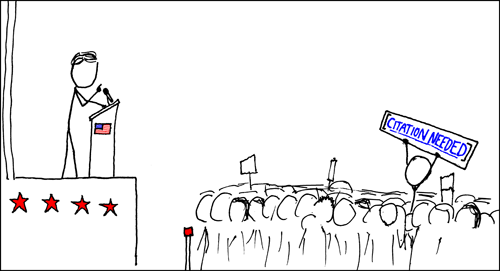
http://imgs.xkcd.com/comics/wikipedian_protester.png

Thursday, February 4, 2010

The gravity of punctuation.

Punctuation sometimes makes a huge difference. Today on BoingBoing a great dialogue rages on regarding the dangers of careless punctuation. I dream of the day when I get dialogue like that on one of my blogs. But be warned - at least one comment is off color.

The first comment correctly punctuated is wholesome, but the slightest slip and it implies something obscene. Examples like that illustrate the richness and the fun of language, and could forestall embarrassing mistakes by students, but could a discussion like that get me in trouble?

Punctuation has real world implications - for example the time conservative California judges had to allow same-sex marriage because the lawmakers who passed legislation against it misplaced a semicolon.

My question, can and should we have these discussions? What is acceptable language? Is it about topics, ideas, or merely about word choices? Many students this semester go to church regularly and characterize themselves as devout. How (or should) we filter dialogue?

I went to catholic school 6 yrs., and have taught in at least 2 church colleges/universities. Religious schools counter-intuitively allow discussions that might get a teacher in trouble at a public institution. What's the consensus with our group(s)?